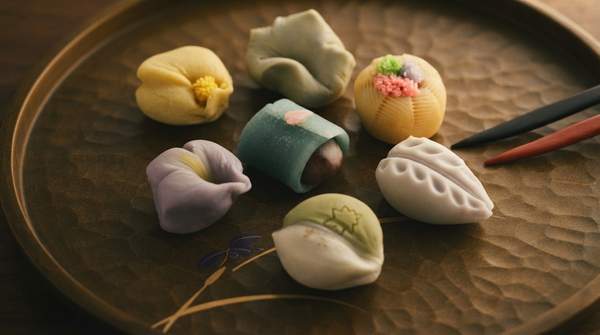
Walk into a wagashi shop in Tokyo versus one in Osaka during cherry blossom season, and you may be handed two confections that share a name but almost nothing else. Both are sakura mochi, yet the Kanto version is a soft anko paste rolled inside a thin, crepe-like wheat sheet, while the Kansai version is a light pink ball of chewy glutinous rice grains wrapped around the filling. That single contrast captures what makes wagashi, Japan's traditional confections, so distinctive: geography and the calendar shape these sweets as much as sugar does.
The Cultural Significance of Wagashi
Wagashi were traditionally made to accompany the tea ceremony, and that origin explains much of their character. According to Japan's Ministry of Agriculture, Forestry and Fisheries, the Japanese have long appreciated the four seasons, and wagashi has represented those seasonal changes; its culture developed in close connection with Japanese lifestyle and annual seasonal events. An NHK program on the language around wagashi makes the same point from the other direction: because the sweets reflect the seasons, they have generated many unique Japanese expressions, to the extent that a poet and literary translator based in Kyoto devoted an entire episode to the words and culture behind them.
Historically, Kyoto set the aesthetic standard. Kyoto-styled wagashi, known as Kyo-gashi, were noted for their elaborate, decorative appeal and were crafted to reflect seasonal changes, aligning with the tea ceremony's emphasis on nature and contemplation. As the tea ceremony popularized wagashi more broadly, Edo—present-day Tokyo—developed a simpler variation known as Jyo-gashi, making the confectionery accessible to the growing middle class. In broad terms, Kyoto artisans focused on decorative sweets while Tokyo favored more practical, everyday confections, a divergence that still flavors regional styles today.
Comparing Regional Wagashi Styles
The clearest way to see regional divergence is to put the two sakura mochi side by side, as the Tokyo gourmet guide published by the city's official tourism body does: the confection wraps sweet boiled bean paste, anko, in a rice-based dough, is encased in salted sakura leaves, and differs by region. Japanese culture writer Kaji Mari traces the Kanto style to 1717, when Yamamoto Shinroku began selling it in front of Chomeiji Temple by the Sumida River—his shop still operates in Tokyo's Mukojima district. Juxtaposing the styles isolates what defines each.
| Region | Example | Key characteristics (appearance/ingredients) | Texture | Origin/context |
|---|---|---|---|---|
| Kanto (Tokyo area) — "Chomeiji" style | Sakura mochi | Anko rolled inside a thin, crepe-like wheat flour sheet | Moist and soft | Said to have started in 1717 at Chomeiji Temple by the Sumida River; the shop continues in Mukojima, Tokyo |
| Kansai (Osaka/Kyoto area) — "Domyoji" style | Sakura mochi | Coarse grains of domyojiko (steamed glutinous rice, dried and roughly ground) wrapped around anko in a ball shape; light pink | Chewy and grainy | Regional counterpart to the Kanto style, wrapped in pickled sakura leaves |
| Kyoto | Kyo-gashi | Elaborate, decorative sweets crafted to reflect seasonal changes | Refined | Aligned with the tea ceremony's emphasis on nature and contemplation |
| Edo (present-day Tokyo) | Jyo-gashi | A simpler variation on wagashi | Everyday | Emerged as the tea ceremony popularized wagashi, making confectionery accessible to the growing middle class |
With the table in view, the distinction becomes easy to apply: if your sakura mochi looks like a pale pink rice ball with visible grains, it is Kansai style; if the filling is enveloped in a soft crepe sheet, it is Kanto. Kaji also notes that the salted leaf is optional—you can eat it or take it off, and the salt and aroma pull the sweetness together if eaten together.