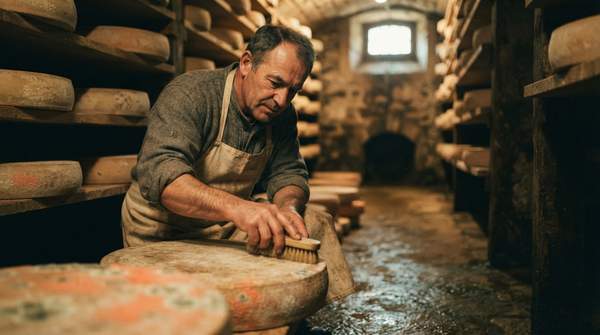
Every great artisanal cheese is, at its heart, a managed fermentation. The flavors and textures that make a Camembert, a Livarot, and a Roquefort unmistakably different are not added by the cheesemaker — they are produced by microbes, working under deliberately controlled conditions, as the cheese ages. A scientific review of cheese flavor development puts it plainly: alongside rennet and the milk's own native enzymes, the cheese microbiota is a primary source of the enzymes driving the biochemical pathways of ripening, and so it plays the key role in shaping the sensory properties of the final product. Understand which organisms are working, where they live on the cheese, and what conditions the aging room enforces, and you can read a cheese's character before you ever taste it.
Key Biochemical Pathways: Flavor and Texture Creation
Let me walk you through the three great transformations, because everything else in this story hangs on them. Cheese begins as milk — a matrix of proteins, fats, and the sugar lactose. In a young wheel, that matrix is bland. What ripening does is set armies of enzymes loose on it, and most of those enzymes come from the microbes themselves rather than from the milk or the rennet.
The first pathway is proteolysis: the breakdown of milk proteins into ever-smaller fragments — peptides and free amino acids. This matters twice over. It changes texture directly, because intact protein structure is what holds a cheese firm; as proteins are dismantled, a once-rubbery curd softens and spreads. And it changes flavor, because the smaller fragments are themselves taste-active and serve as precursors that other microbes convert into aromatic compounds. In blue-veined cheeses, proteolysis is, according to a review of blue cheese ripening, the most complex and important primary biochemical process, with the mold Penicillium roqueforti acting as the main proteolytic agent.
The second pathway is lipolysis: the breakdown of milk fat. Fats are cleaved into free fatty acids and further derivatives, and in blue cheeses this process is strong — the same review identifies ketones, arising from lipolysis, as the main aroma compounds in blue-veined varieties. This is the chemistry behind that pungent, sharp, spicy blue character. And lipolysis is not exclusive to blues: the mold Penicillium camemberti, which ripens surface-mold cheeses such as Camembert and Brie, also produces lipases that contribute to the characteristic flavor development of white mold-ripened varieties.
The third pathway is glycolysis — the metabolism of lactose. This is the earliest actor, and largely the starter cultures' job: the bacteria added at the outset ferment the milk's sugar into lactic acid. That acidification does two essential things. It helps set the curd and expel moisture, and it establishes the acidic environment that determines which later microbes can thrive. In effect, the starter bacteria set the stage on which the surface molds, smears, and ripening flora will perform.
What strikes me about the whole system is how conditional it is. The same review on flavor development notes that the outcome depends on the type and composition of the milk, the processing conditions, and the biochemical reactions of the microorganisms present in the cheese matrix. Change any of the three — the milk, the process, or the microbes — and you change the cheese. That is why ripening is managed, not merely awaited.