Yes, you can make authentic Neapolitan pizza dough at home — but authenticity has a definition, and it isn't loose. The Associazione Verace Pizza Napoletana (AVPN) has written an International Regulation that governs everything from the four permitted ingredients to the wood-fired oven itself. Follow the rules, respect a long fermentation, and you can produce a dough worthy of the name. Here's the standard, a tested recipe, and the temperature know-how that separates a good dough from a true one.
Understanding Authentic Neapolitan Pizza: The AVPN Standard
So what makes a pizza "Neapolitan" rather than merely pizza? The AVPN's International Regulation is the heart of the association's mission to protect the old recipe and defend its uniqueness. The regulation describes the finished pizza precisely: it must be roundish, with a maximum diameter of 35 centimeters, and it must present a raised edge — the famous cornicione — swollen, free from burns, and standing 1–2 centimeters high. The pizza must be soft and fragrant.
Cooking is where the standard gets demanding. The AVPN requires that cooking be done exclusively in a wood-fired oven that has reached a temperature between 430 and 480°C; at those temperatures, the pizza goes in for just 60 to 90 seconds and cooks evenly across its entire circumference. That's the bar. Everything in the dough-making process exists to survive and flourish in that brief, ferocious bake.
Essential Ingredients for Neapolitan Pizza Dough
The ingredient list is almost disarmingly short: water, salt, yeast, and flour. That's it. The AVPN's recipe, written down from the old generation of pizzamakers, permits nothing else in the dough — no oil, no sugar, no enhancers. When your list is this short, quality and measurement carry all the weight.
For flour, you want a finely milled "00" pizza flour. Two expert recipes point the way: Chef Domenico "Mimmo" Tolomeo's traditional dough for Caputo calls for 1 kilogram of Caputo "00" Pizzeria Flour, while Vincenzo Prosperi's recipe on Vincenzo's Plate uses 1 kilogram of Le 5 Stagioni Napoletana Pizza Flour. Both scale to about six 12-inch pizzas, so halve the quantities if your kitchen (or appetite) is smaller.
Step-by-Step Neapolitan Pizza Dough Recipe
Here is the recipe as Caputo's Chef Mimmo Tolomeo specifies it, yielding six pizzas with a 26-hour preparation window and a 2-minute cook. Combine 3 grams (1 teaspoon) of instant yeast, 1 kilogram of Caputo "00" Pizzeria Flour, 640 grams of water, and 30 grams of salt. That hydration — 64 percent — is what makes the dough soft and elastic enough to stretch by hand.
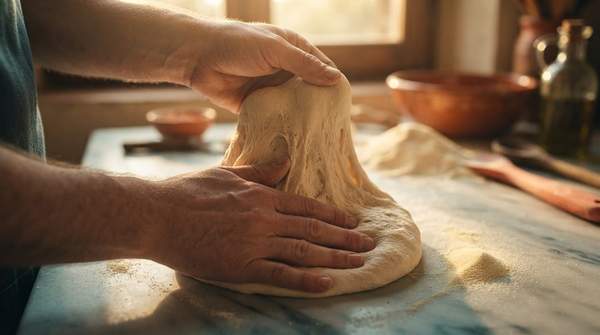
Prosperi's version runs parallel: 600 milliliters of room-temperature water and 1 kilogram of flour, with a 30-minute active prep, a rise of one day and two hours, and a 2-minute bake. Dissolve the yeast in the water, add the flour and work it until it comes together, then add the salt and knead until the dough is soft and elastic. You need nothing more than a large mixing bowl, bench space, and your hands — a stand mixer is optional. Once kneaded, the dough waits, and that waiting is where the character is built.
Mastering Fermentation: Time, Temperature, and Flavor Development
This is the part most home bakers rush, and it's the part that matters most. Both expert recipes commit to a long fermentation — roughly 24 to 26 hours — with a very small amount of yeast. Why so little? Because time, not yeast quantity, is doing the work of developing flavor and texture.
Temperature is the variable you must manage. Prosperi passes along guidance from a pizzaiolo named Johnny who recommends 16–18°C for the 24-hour proof. If your kitchen sits at 24°C, as one reader's did, Prosperi's advice is direct: reduce the yeast slightly, or let the dough proof in the refrigerator for part of the fermentation to slow it down. Then bring the dough back to room temperature for 3–4 hours before stretching, so it can relax and become workable. Neither cold nor warm fermentation is right or wrong, he notes — they're just different routes to a great result. The principle to internalize: warmer means faster, so compensate with less yeast or more cold.
Shaping and Cooking Your Neapolitan Pizza
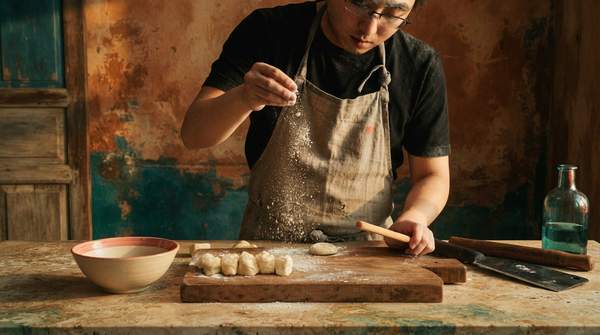
When shaping time arrives, hands only. The AVPN tradition is explicit that the dough is stretched by hand — a rolling pin has no place here, because it crushes the gas cells that create the swollen cornicione. Chef Tolomeo dusts with Caputo semolina for stretching, which keeps the dough from sticking while adding a whisper of texture to the base.
Now, the honest limitation: the AVPN requires a wood-fired oven at 430–480°C, and a standard home oven cannot get there. Chef Tolomeo's recipe acknowledges this by recommending a high-heat oven such as an Ooni, Gozney, or Breville, targeting around 900°F for a 60-to-90-second cook. Timing is everything at that heat — launch quickly and watch closely to avoid burning. Without specialized equipment, you can still make excellent dough, but the official cooking standard will be out of reach.
Authentic Neapolitan Pizza Dough: AVPN Compliance Checklist
Use this table to check your process against the official standard. If every row reads "yes," your dough, method, and result align with the AVPN's definition of Verace Pizza Napoletana; any "no" tells you exactly where you've departed from it.
| Aspect | AVPN Standard / Expert Guidance | Your Home Application |
|---|---|---|
| Flour type | "00" pizza flour; expert recipes name Caputo "00" Pizzeria and Le 5 Stagioni Napoletana | Use a "00" pizza flour — check yes/no |
| Basic components | Only water, salt, yeast, and flour in the dough | No oil, sugar, or additives — check yes/no |
| Mixing and shaping | Dough must be soft and elastic; shaped by hand, rolling pin prohibited | Hand-stretch only — check yes/no |
| Fermentation | Long fermentation of 24+ hours; reduce yeast or refrigerate part of the proof when ambient temperature exceeds the recommended 16–18°C | 24–26 hour schedule with temperature adjustment — check yes/no |
| Cooking | Wood-fired oven at 430–480°C for 60–90 seconds | High-heat oven (e.g., Ooni, Gozney, Breville) — check yes/no |
| Final product | Roundish, maximum 35cm diameter, raised swollen cornicione of 1–2cm, soft and fragrant | Compare your baked pizza — check yes/no |
Achieving Authenticity: Your Next Steps
To consistently make authentic Neapolitan pizza dough at home, prioritize precise ingredient measurements, commit to a long fermentation schedule with temperature adjustments, and aim for the highest possible oven temperature. Weigh your flour, water, salt, and yeast rather than scooping and guessing; give the dough its full day-plus of fermentation, cutting the yeast back or using the refrigerator if your kitchen runs warmer than 16–18°C; and get your oven as close to that 430–480°C window as your equipment allows.
You'll know you've succeeded by three observable signs: the dough exhibits a soft, elastic texture after kneading, develops a rich flavor after 24 or more hours of fermentation, and the baked pizza shows a visibly raised, airy cornicione. When those three things are true at once, you haven't just made pizza — you've made it the way Naples says it should be made.
Sources
- AVPN International Regulations
- Neapolitan Pizza — Caputo Flour
- How to Make Neapolitan Pizza Dough like World Best Pizza Chef — Vincenzo's Plate