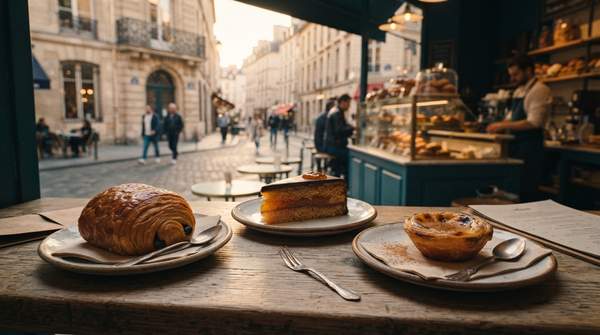
If you're planning a dessert-focused trip to Europe, your real choice isn't which continent or which season—it's which patisserie culture you want to wake up to each morning. The three capitals worth comparing are Paris, Vienna, and Lisbon, and they could not be more different. Paris offers laminated doughs and precision choux; Vienna answers with dense, chocolate-layered imperial cakes served in grand coffeehouses; Lisbon counters with blistered egg custard tarts born from monastic kitchens. Here's how to compare them, and how to decide.
Europe's Patisserie Capitals: Paris, Vienna, and Lisbon
Why these three? Because each represents a distinct branch of the European dessert tradition. As one culinary travel guide frames it, "history, geography, and culture shape global dessert traditions," and these cities sit at three different historical crossroads: a French royal court tradition of refined pastry work, an Austro-Hungarian imperial café culture, and a Portuguese conventual tradition built on egg yolks and cinnamon. A broader travel perspective notes that France, Austria, and Portugal are among the countries "especially known for pastry traditions connected to historic cafés, imperial culinary culture, and regional baking techniques."
Each city also runs on its own rhythm. The same comparison suggests Paris bakeries are best visited in the early morning, Lisbon's in the warm midday batch hours, and Vienna's in the afternoon, when the coffeehouse ritual of afternoon tea takes over.
Paris: The Art of Laminated Doughs and Classic Creations
Paris is the city of technique. Its signature ingredients are high-fat French butter and patient, layered dough work—"laminated dough & precision choux," as one pastry-town comparison puts it. The classics you'll encounter range from delicate macarons to yeasty croissants to the rum-soaked baba, and tasting a mix of old and new is, as one food writer puts it, "a beautiful way to get to know the city."
For history, start at La Maison Stohrer on rue Montorgueil. Founded in 1730 by Nicolas Stohrer—pastry chef to King Louis XV, and before that to Stanisław Leszczyński, King of Poland—it is credited as the oldest pâtisserie in Paris. The house still prepares everything in-house, and its own account credits Stohrer with inventing the rum baba, Chiboust cream tarts, and traditional-style religieuses, alongside its exceptional vol-au-vents. The shop is now listed as a historical site, with lavish décor designed by a student of Paul Baudry, who decorated the Opéra Garnier.
Then there's Ladurée, established in 1862, where Jeanne Souchard—Ernest Ladurée's wife—merged the patisserie with the café to create one of Paris's first tea rooms. A few years later, Pierre Desfontaines created the double-shell macaron that became the house signature and, in the company's telling, "the symbol of chic à la française."