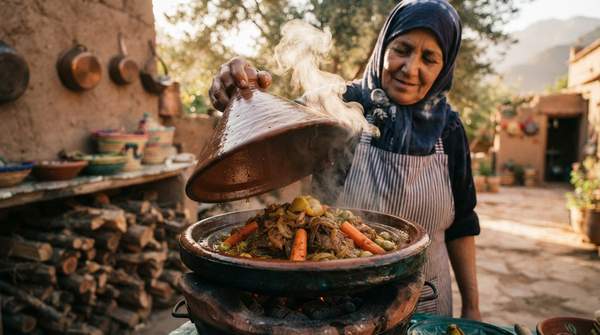
Ask anyone who has eaten from a proper Moroccan tagine what makes it different, and you will hear the same few words: tender, moist, concentrated. The secret is not a spice or a technique alone — it is geometry. A tagine's tall conical lid turns an ordinary braise into a closed loop of steam, condensation and return. The pot effectively bastes itself, which is why North African cooks have leaned on this shape for centuries to produce rich dishes from little more than a splash of liquid.
The Tagine's Conical Design: An Overview
The tagine is deceptively simple: two pieces, no machinery. A round, shallow base holds the meat, vegetables, oil and a modest amount of liquid, while a tall pointed lid sits on top like a chimney. Tilda's equipment guide describes the lid as acting "as a funnel" — a description that captures the whole mechanism in a single word. Heat enters through the base, but the cone above determines where the moisture goes.
What the shape buys you is surface area and elevation. A flat lid gives rising steam nowhere to travel except straight up into a cool spot a few centimeters above the food. A cone forces that same steam to climb, spreading it across a large, sloping surface where it inevitably cools. Every culinary description of the tagine, from equipment guides to buying guides, returns to this one idea: the lid is designed to catch steam and send it back down rather than let it escape.
Eater's guide to choosing a tagine puts the payoff plainly, noting that the conical lid "is designed to return condensation to bottom of the pot, allowing the spices and herbs to mingle without relinquishing any of that delicious flavor out into the air." Nothing is vented away; nothing is diluted. What you put in is what you taste, intensified.
The Tagine's Self-Basting Cycle Explained
To understand why the shape works, it helps to slow the cooking down and watch it one stage at a time. The process is continuous in practice, but each stage has its own physics. Here is the full cycle, reconstructed from the culinary descriptions:
| Stage | What happens | Effect on the food |
|---|---|---|
| 1. Heating the base | Low, steady heat conducts through the shallow base into the ingredients, oil and liquid. | Gentle simmering without scorching; gradual cooking. |
| 2. Steam generation | Moisture released by the food and any added liquid turns to vapor as the pot warms. | The enclosed environment begins building; flavors start to mingle. |
| 3. Rising and cooling | Steam rises and is trapped inside the tall cone, cooling as it climbs the large sloping surface. | Volatile aromas stay in the pot instead of escaping. |
| 4. Condensation | Cooled vapor condenses into droplets on the inner walls and peak of the lid. | Flavor-carrying liquid is recovered rather than lost. |
| 5. Liquid return | Droplets run down the cone's sides and drip back onto the ingredients below. | Continuous self-basting: moist, tender, concentrated results. |
The loop then repeats for as long as the pot sits over heat. Tilda's guide describes exactly this sequence: as the tagine warms, moisture "turns to steam, which rises up and is trapped inside the cone," then "condenses at the peak and the moisture returns down the sides, basting the ingredients as it goes." The result of that cyclical process, the guide adds, is food that comes out "moist and slightly caramelised."