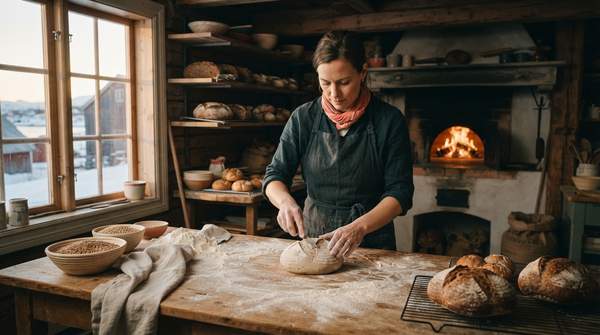
Scandinavian baking traditions are a rich tapestry woven from centuries of history, the diverse climates of the Nordic region, and the grains that have sustained its people. These fundamental influences have shaped not only the ingredients chosen but also the core baking techniques, particularly for breads, reflecting a deep communal heritage and an intimate connection to the land. As we delve into these traditions, we uncover how historical periods, available grains, and regional climates have sculpted distinct bread cultures, offering a pathway to confidently recreate these culturally significant baked goods at home.
The Ancient Roots of Scandinavian Baking
The journey of Scandinavian baking began long ago, with its earliest traces found in the Bronze Age, spanning from approximately 1800 BC to 500 AD. During this era, oats and spelt, a type of wheat, were among the most commonly cultivated and utilized grains. The advent of early ovens, appearing around 400 AD, marked a significant step, likely used for baking small loaves of what might have been the first true breads.
External cultural exchanges played a pivotal role in the evolution of these practices. Wikipedia's account of Nordic bread culture notes that Scandinavian soldiers, serving as mercenaries in the Roman army between 200 and 400 AD, brought back baking techniques learned on the continent. This knowledge, acquired during what was considered high-status work, was then integrated into local customs. Later, German traditions further influenced many of the bread types found across the Nordic countries.
Finland, positioned uniquely between Eastern and Western cultural spheres, developed its own distinct baking characteristics. Western Finland adopted baking and cultivation techniques from Scandinavia, while eastern Finland was exposed to Russian influences. A notable example comes from North Karelia in eastern Finland, where households traditionally baked rye bread in large ovens multiple times a week. These breads often relied on sourdough starters that could be hundreds of years old, demonstrating a deep-rooted tradition of leavening without added commercial yeast. This historical evolution underscores how early grain usage, external influences, and regional cultural dynamics laid the groundwork for the diverse baking landscape we see today.The Four Grains: Regional Impact and Cultural Significance
At the heart of Nordic baking lie four foundational grains: wheat, barley, oats, and rye. The prevalence and cultural significance of each grain vary considerably across the vast Nordic region, a direct consequence of its diverse climates. As Magnus Nilsson explains in *The Nordic Baking Book*, unlike countries with more uniform climates, such as France where wheat predominates, Scandinavia's varied conditions ensure that at least one of these grains has always been crucial in every part of the region.
Rye, for instance, is a dominant grain in northern areas, including Finland and parts of Sweden. Its resilience in colder climates and its unique properties make it particularly suited for sourdough preparation. In these regions, rye bread is more than just a food item; it is a staple, deeply woven into the cultural fabric. The Lefse House emphasizes that traditional Scandinavian recipes celebrate natural ingredients like grains, butter, and seasonal produce, which contribute to their distinct flavor profiles.
Barley and oats also hold significant places, especially in areas where wheat cultivation is challenging. While they do not possess the same gluten content as wheat, leading to denser breads, their hardiness makes them invaluable. Wheat, though less ubiquitous than in more temperate zones, is still important, particularly in southern Scandinavia where conditions are more favorable. The choice of grain directly influences the texture, flavor, and cultural role of the bread, from the hearty, dark rye loaves of the north to the lighter, softer wheat-based breads found further south.Sourdough and Traditional Leavening Methods
Sourdough stands as a cornerstone of traditional Scandinavian bread culture, particularly integral to rye baking. This time-honored leavening method reflects a profound communal heritage, where sourdough starters were often maintained and passed down through generations, as exemplified by the centuries-old starters used in eastern Finland. The Lefse House highlights that Scandinavian baking is defined by its time-honored techniques, natural ingredients, and a strong emphasis on community.
The process of sourdough fermentation, which relies on wild yeasts and lactic acid bacteria, imparts a distinct tang and complex flavor profile to breads that commercial yeast cannot replicate. This method is especially beneficial for rye flour, which has lower gluten content than wheat and benefits from the acidity of sourdough to develop structure and improve digestibility. The reliance on sourdough in colder northern regions also speaks to its practicality; wild yeasts are more resilient in varying temperatures compared to commercial yeasts, which require more controlled conditions.
This traditional approach stands in contrast to modern industrial baking trends, which often prioritize speed and consistency through the use of commercial yeasts and additives. While industrialization has made bread more widely available, it has also impacted the diversity of regional variations and the prevalence of traditional methods. However, the enduring appeal of sourdough underscores a continued appreciation for authentic, slow-fermented breads that connect us to historical practices and the community spirit of Scandinavian baking.
Climate's Hand: Shaping Regional Bread Types
The climate exerts a profound and undeniable influence on the baking techniques and the types of breads prevalent across the Nordic region. This environmental factor dictates not only which grains can be successfully cultivated but also the feasibility of different leavening methods.
In southern Scandinavia, where temperatures are generally milder, soft, leavened breads are more common. These warmer conditions are conducive to the cultivation of wild yeast cultures, which are essential for achieving the light, airy texture characteristic of such breads, as noted by Great British Chefs. The availability of wheat in these regions further supports the production of these softer, often richer, leavened loaves.
As one travels further north into areas like the Swedish midlands, Norway, and Finland, a distinct shift occurs. Crispbreads and flatbreads become significantly more prevalent. These breads, often baked on hot stones or later in wood-fired ovens, are typically denser and flatter. This change is largely attributable to the scarcity of wheat in colder northern climates. Grains like barley and rye, which are more resilient and thrive in these conditions, do not possess the same gluten content as wheat. As Magnus Nilsson details, this results in breads that do not achieve the same structure when baked, leading to the characteristic flatness and density of northern breads. This direct link between regional climate and available grains dictates the type of bread produced, favoring less leavened, more robust options in colder areas where survival often depended on hardy, storable provisions.From Hearth to Factory: Modern Shifts in Baking
The evolution of Scandinavian baking has witnessed a significant transformation, moving from traditional home-based production to more industrialized factory settings. This shift, driven by modern advancements, has inevitably impacted regional variations and traditional methods, altering how bread is produced and consumed across the Nordic countries.
Industrialization has introduced new efficiencies and made bread more accessible, leading to a mix of international bread types alongside older, traditional ones. Bread is now integrated into new meal settings and food innovations, such as yogurt with bread or fast-food bread, as Wikipedia observes. While these modern trends have broadened the culinary landscape, they have not entirely erased the deep-seated traditional practices.
The Lefse House emphasizes that the art of Scandinavian baking continues to celebrate heritage, community, and sustainability. There is a strong encouragement to embrace authentic ingredients and traditional methods to elevate baking, even in contemporary kitchens. Many bakers today experiment with heritage recipes, adding a personal touch to their creations, and connect with local producers to ensure quality and freshness. This blending of tradition with modern techniques allows for innovation while still honoring the historical and regional influences that define Scandinavian baking. The ongoing culinary journey in Scandinavia demonstrates a dynamic interplay between preserving a rich past and adapting to a changing world, ensuring that the heart of its baking traditions continues to beat strong.