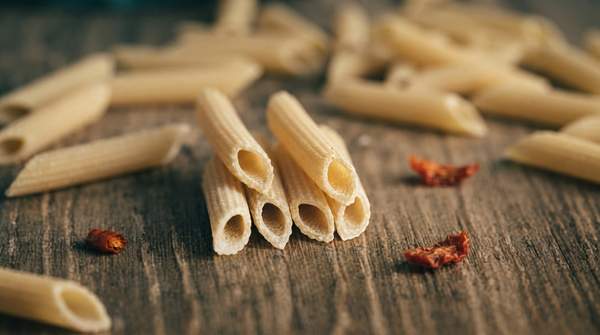
Why does one box of rigatoni grab a hearty ragù while another lets it slide off into the plate? The answer, more often than not, is hidden in the factory: the material of the die the dough was pushed through. Pasta extruded through bronze dies emerges rough and porous, a surface built to capture sauce. Pasta pushed through Teflon inserts comes out even and smooth, holding sauce far less readily. Once you can spot the difference—by sight and by label—you can match pasta to sauce with confidence.
The Science of Pasta Texture: Why Dies Matter
Most short and tubular dried pastas—penne, rigatoni, casarecce—are not rolled out; they are extruded. Dough is forced under considerable mechanical pressure through a die, a plate pierced with shaped openings, while the pasta is still in what industry writers describe as a "plastic" state. That pressure is strong enough that dies are sometimes automatically cooled to prevent the dough from overheating. The die does more than shape the pasta, though: its surface is stamped onto every piece that passes through. As the trade publication Italian Food Tech explains, dies made entirely of bronze leave the pasta surface rough, while Teflon inserts give the product an even surface and a smoother texture. The material, in other words, is a texture decision made before the pasta ever reaches a pot.
Bronze Dies: The Secret to Sauce Adherence
Bronze is the traditional die material, and its effect is mechanical rather than mysterious. The metal leaves a rough, slightly porous surface on the extruded pasta, and that roughness is exactly what a sauce wants. Italian Food Tech notes that the rough surface "helps to capture the sauce," and that bronze-extruded pasta also has higher porosity than its smooth counterparts. Every groove and micro-texture becomes a foothold for a thick ragù, a chunky vegetable sugo, or a rich meat sauce that would otherwise pool at the bottom of the bowl. The porosity carries trade-offs on the production side—the same source reports it reduces breaking strength and can make the surface more hospitable to insect egg deposition during storage—but for the home cook, the culinary payoff is straightforward: sauce clings, and each bite carries flavor.
Teflon Dies: Smoothness for Delicate Dishes
Teflon inserts produce the opposite result: an even surface and a smoother texture, in Italian Food Tech's description. This smoothness has real advantages in manufacturing and presentation—the pasta looks uniform and glossy on the shelf—but it changes how the cooked pasta interacts with sauce. A smooth surface simply offers less to grip. Thick, chunky sauces tend to slide off, which is why smooth pasta is generally the better companion for lighter, more delicate preparations where you don't need aggressive adherence—thin oil-based dressings or brothy dishes where the sauce coats rather than clings. Neither die is "better"; they are tools for different jobs, and knowing which one shaped your pasta tells you what it can carry.
Bronze vs. Teflon: A Pasta Die Comparison for Home Cooks
The table below distills the cause-and-effect chain: die material determines surface texture, surface texture determines sauce behavior. Read it before you shop, and you can pick the right box for tonight's sauce in seconds.
| Extrusion Die Material | Resulting Surface Texture | Key Characteristics | Ideal Sauce Pairing |
|---|---|---|---|
| Bronze die | Rough and porous | Rough surface captures sauce; higher porosity, though this reduces breaking strength | Hearty, thick, chunky sauces that benefit from clinging |
| Teflon die insert | Even and smooth | Uniform appearance; does not cling to sauce as readily | Lighter, delicate sauces where a smooth texture is preferred |
The verdict the comparison delivers: bronze-die pasta is the one built for capturing and holding sauce, so when maximum flavor delivery is the goal, that is the box to reach for.
Beyond the Die: The Role of Flour and Dough Composition
The die only finishes the story; the dough starts it. Extruded pasta is typically made from semolina and water—no eggs. Writing for Pastidea, Giulia Prazza lists the shapes that suit this composition, from spaghetti and penne to rigatoni, cavatelli, and malloreddus, and cautions that adding eggs to these shapes "may alter the flavor and make the pasta rubbery." Semolina matters for structure, too: Italian Food Tech notes that the gluten strength of the semolina greatly determines the break strength of dry pasta, which predicts how well the product tolerates transportation and cooking.
Consistency is the other half of the equation, and it is counterintuitive for anyone used to fresh, kneaded dough. Extruded dough should not resemble bread dough at all. Rafal Cichon, writing for Orlando Foods, describes the ideal texture as looking "more like damp sand," and Prazza gives a practical field test: squeezed in the palm, the dough should compact easily; rubbed between the fingers, it should crumble again. Orlando Foods also recommends mixing for at least ten minutes so the flour fully absorbs the liquid, and letting the dough rest briefly before extrusion. This grainy, barely-hydrated consistency is what allows the dough to pass cleanly through the die without sticking or tearing—and it is part of why extruded shapes hold their rustic, sauce-friendly character.
Making Your Choice: Pairing Pasta with Sauce
Putting it all together gives you a simple decision framework. First, decide what the sauce needs. If it is thick, chunky, or rich—ragù, amatriciana, a hearty vegetable sauce—choose bronze-die pasta, whose rough, porous surface will capture it. If the sauce is light and delicate, a smoother Teflon-extruded pasta serves the dish fine, since you are not asking the surface to grip. Second, look at the pasta itself before cooking: a rough, matte, almost chalky-looking surface signals bronze extrusion; a glossy, uniform sheen signals Teflon. Third, remember that shape and composition work alongside the die—semolina-and-water shapes like rigatoni and casarecce are the classic vehicles for robust sauces. This article covers commercially available dried extruded pasta, not fresh laminated shapes like fettuccine or ravioli, and the pairings here are principles rather than an exhaustive recipe list.
Your Next Pasta Purchase: A Textured Decision
When selecting dried pasta, examine the packaging for indications of bronze extrusion—often labeled "trafilata al bronzo"—for sauces that require strong adherence, or choose smoother pasta for lighter, more delicate preparations. The check is easy to perform in the aisle: look at the texture of the uncooked pasta, visibly rough or smooth, and the label indicating "bronze die" or "trafilata al bronzo." Match what you see to the sauce you plan to make, and the pasta will do the rest.
Sources
- Pasta production, mixing and extrusion - Italian Food Tech — Italianfoodtech
- Guide to dough handling for extruded pasta with Philips Pasta Maker » Pastidea
- Mastering Extruded Pasta: Flour, Hydration & Building the Perfect Dough - Orlando Foods — Orlando Foods - Ambassadors of Italian Quality