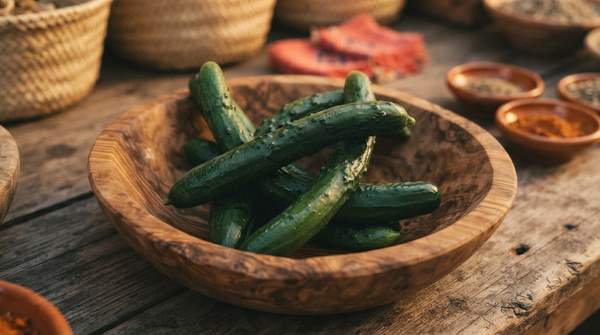
Japanese pickles, or tsukemono, split into two worlds: quick salt pickles you can eat the same day, and slow fermented pickles that take days, weeks, or even months. If you want a crisp, refreshing side dish for tonight's rice and miso soup, the quick method—called asazuke, or "shallow pickling"—is your entry point, and its simplest form, shiozuke (salt pickles), needs about ten minutes of prep and as little as two hours of waiting. Here is how the two approaches differ, and how to make your first batch.
Introduction to Japanese Tsukemono: More Than Just a Side Dish
In America, a pickle usually means a cucumber beside a sandwich. In Japan, tsukemono is far more central: as Ayane Nagura explains in her guide for Umami Insider, these pickles span vegetables, fruits, and even seaweed, made with either a salt or vinegar brine or a more involved fermentation process, and they appear as a main component of a meal rather than a garnish. The category is defined by its method, not by one ingredient.
The name itself hints at its role at the table. Namiko Hirasawa Chen of Just One Cookbook notes that tsukemono is sometimes called kounomono, or "fragrant things," because it contributes color, texture, and aroma alongside its taste. It is a small dish with a big job.
Quick Pickles: The Simplicity of Asazuke and Shiozuke
At home, many Japanese cooks rely on asazuke—"shallow pickling"—because it asks so little. The easiest version is shiozuke, or salt pickles. The process is pure physics rather than microbiology: you salt the vegetables, weigh them down with a heavy object, and the pressure draws out their liquid, which combines with the salt to form a pickling brine through osmosis. No starter culture, no waiting for anything to grow.
Hirasawa Chen's rule of thumb keeps it precise: use 2% to 2.5% of the vegetable's weight in salt—multiply the vegetable weight by 0.02—and use a kitchen scale rather than guessing. The trade-off is shelf life. Because asazuke uses only a small amount of salt, it keeps for just 2–3 days in the refrigerator. You are trading preservation for freshness, and that is exactly the point.
The Art of Fermentation: Complex Tsukemono Methods
The other branch of tsukemono relies on fermentation, often using beds of rice bran (nuka) or miso as the pickling medium. According to Nagura's overview, these methods involve a more involved process in which microbial activity drives both preservation and flavor development over days, weeks, or months. The long wait is not a burden but the mechanism itself: the deep, complex, umami-rich and often sour flavors simply cannot exist without the time that produces them.
These are rewarding crafts, but they demand daily attention and patience that a first batch does not. This article explains their principles but does not walk through them step by step; a nuka bed, in particular, is a living thing you tend rather than a recipe you finish.