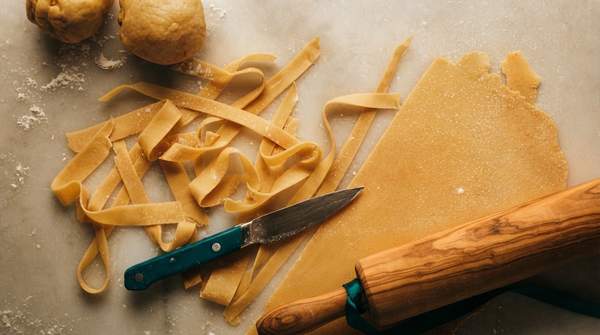
Authentic Italian fresh pasta comes down to one decision before you even touch the flour: egg dough or eggless dough. Northern Italian tradition pairs eggs with finely milled '00' flour for silky, tender ribbons like tagliatelle; Southern tradition pairs semolina with water for firm, chewy little shapes like orecchiette. Get that choice right, and the rest — kneading, resting, shaping — follows naturally. Here is a decision framework, two complete recipes, and the shaping steps for each classic form.
The Regional Divide: Egg vs. Eggless Pasta Dough
Travel through Italy and the pasta itself tells you where you are. As the writer behind The Italian Dish blog explains, different regions make pasta differently: some places use only eggs and flour, others only water and flour, and some cooks add a little salt and olive oil while others skip both. That regional habit is the foundation of everything else.
The flour follows the same geography. InRome Cooking's guide notes that '00' flour is ground so finely it is almost powder-like, which contributes to stretchability and smoothness — the quality behind silky pasta dough. All-purpose flour, by contrast, is slightly coarser, and you can feel the individual wheat particles if you pay attention to the grain. Semolina, the flour of the South, is coarser still and high in gluten, which is why it binds so well with nothing more than warm water.
Emily, the home cook behind the Inside the Rustic Kitchen step-by-step dough guide, describes the Northern egg tradition vividly: in Italy there is even egg sold specifically for pasta, called 'Pasta Gialla' — yellow dough — because the bright orange yolks give the pasta its beautiful color. Her general rule is one large egg to every 100 grams of '00' flour, and she stresses that egg size matters: stick to large eggs, or you will need less flour.
Decision Framework: Choosing Your Dough
So how do you decide? Map what you want to eat onto what the dough naturally does. If you are dreaming of long, silky ribbons that curl around a sauce, you want the Northern egg dough. If you want small, sturdy shapes with a satisfying chew that catch sauce in their hollows, you want the Southern semolina-and-water dough. The table below makes the connection explicit.
Pasta Dough Decision Framework
| Dimension | Northern Italian Pasta | Southern Italian Pasta |
|---|---|---|
| Regional style | Dough typically includes eggs | Primarily made without eggs |
| Primary ingredients | Eggs and '00' flour; about 100g flour per 1 large egg, with optional salt and olive oil | Semolina flour and water; about 100g semolina to 50ml water, with optional salt |
| Flour type | Fine, powder-like '00' flour (all-purpose can substitute, but '00' is traditional) | Coarse semolina, high in gluten, which binds with water into a strong, pliable dough |
| Dough character | Strong and pliable after about 10 minutes of kneading; smooth and elastic | Firm and chewy once cooked |
| Typical shapes | Tagliatelle, pappardelle, fettuccine — rolled and cut | Orecchiette and other small hand-shaped forms |
| Best for | Silky, tender long pastas | Firm, chewy small shapes that trap sauce |
Read the table as a flow: pick your texture, and the ingredients follow. Silky and tender points you to eggs and '00' flour; firm and chewy points you to semolina and water.