Choosing the right flatbread can make or break a curry dinner, and the choice comes down to one simple question: how wet and how rich is your curry? A heavy, rich gravy needs a sturdy partner, while a delicate, subtle dish gets overwhelmed by too much butter — a point made plainly by the North Carolina restaurant Urban Turban, which argues that picking your bread is "the most critical choice of your meal." Here is the practical logic, distilled from multiple culinary sources, for three of the most common flatbreads: naan, roti, and paratha.
Understanding Indian Flatbreads: Naan, Roti, and Paratha
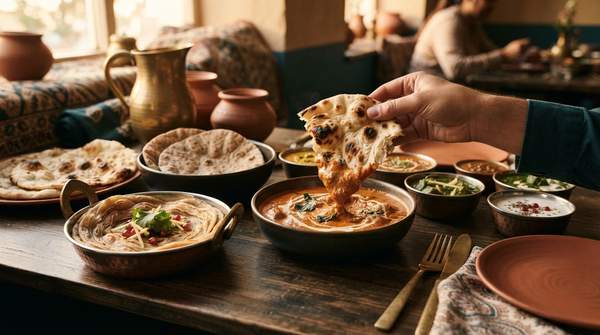
These three breads differ in leavening, fat, and flour — and each structural difference points to a different job on the plate. Naan is a leavened bread: traditional versions are made with white flour, yeast, yogurt, and eggs, then baked in a clay oven, a method described for the closely related Persian taftan by Tasting Table. That leavening gives naan its signature body and chew.
Roti sits at the opposite end of the spectrum. As Tasting Table notes, plain whole wheat roti — just flour and water, unleavened — remains the most prevalent kind, though the family includes finger millet and rice flour variations across North and South India. Cooked on a tawa over a flame until it develops a few charred spots, it is thin, soft, and unadorned.
Paratha occupies the middle ground: a layered or flaky bread that, depending on the recipe, may be cooked with oil or ghee and served plain or stuffed with vegetables, according to the pairing guide from Turmeric Restaurant. Where naan gets its structure from fermentation, paratha gets its character from fat worked into layers of dough.
The Art of Pairing: Texture Meets Consistency
The clearest statement of the pairing principle I found comes from the restaurant group Curry Up Now, whose guide reduces everything to two variables: "Pairing comes down to how wet the dish is and how rich it already is. A thin bread handles a thick curry, and a plain bread handles a rich one."
That logic works in both directions. Because naan features more body and chew than unfermented flatbreads like roti or phulka, as the Gwalia Sweets guide explains, it handles rich, emulsified sauces and chunky vegetable curries exceptionally well — the elasticity needed to scoop heavy curries without tearing. Meanwhile, a plain unleavened bread lets the flavor of a highly spiced curry shine without piling richness onto richness. And when a dish is dry, the fat in the bread itself compensates for the missing sauce. Turmeric Restaurant's guide frames the same decision through the curry's flavor, thickness, spice level, and ingredients — the ideal pairing shifts with each of those qualities. These are culinary conventions, not strict rules, but the underlying physics of bread and sauce is remarkably consistent across sources.