Here is the short answer I wish someone had given me years ago: the flour determines the pasta. If you want silky, tender sheets for tagliatelle, you want a finely milled soft wheat flour—typically a "00"—with enough protein to hold the dough together. If you want a firm, chewy, golden bite, you want semola rimacinata, milled from durum wheat. And if you want something quieter and more rustic—sweet, nutty, dense—you reach for chestnut flour, blended with wheat. The number on the bag, I learned the hard way, tells you almost nothing on its own.
Understanding Italian Flour: Beyond the Numbers
Italian flour classification runs from 00 through 0, 1, and 2, and the scale describes refinement—how finely the grain is milled—not strength. As the food writer Laurie Boucher puts it, "You can have a 00 flour intended for cakes, with a low protein content, and a 00 flour formulated for bread or pasta, with a much higher protein content. Both are finely milled, and can share the same soft and powdery texture, but they can have very different characteristics and applications."
So don't choose a flour simply because the package says 00. Look beyond the number. The higher the number, the coarser the grind: a Type 0 flour may retain some wheat bran, and Types 1 and 2 are coarser still, with more bran and typically more protein. Gianluca Deiana, writing for Zafferano & Co, is blunt about the misconception: "The number '00' describes refinement—not strength." A Type 00 formulated for fresh pasta behaves very differently from one developed for Neapolitan pizza or panettone.
What should you check instead? The protein percentage. As a general guideline Deiana offers: around 9–10% protein suits cakes and delicate pastries; 11–12% works well for fresh pasta and everyday baking; 13–15% is preferred for artisan pizza and long-fermentation doughs. For pasta night, aim for that middle band.
Soft Wheat Flour ('00' Grano Tenero): For Delicate Pasta
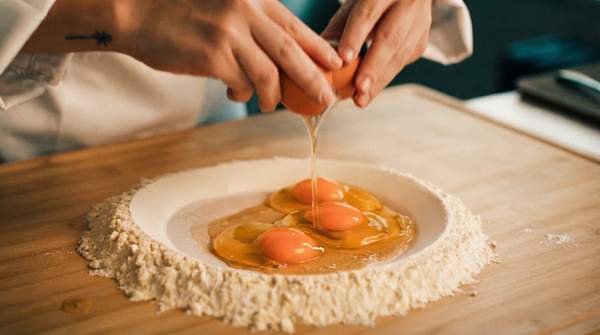
Soft wheat—grano tenero, Triticum aestivum—is the grain behind almost all Italian flour. Its kernels mill easily into a fine powder, and its gluten is generally more extensible, meaning the dough stretches without tearing. That extensible quality is what makes it indispensable for fresh egg pasta: you can roll a soft wheat dough thin enough to see the shadow of your hand through it, and it will still drape rather than crack.
A "00" grind of soft wheat gives you the silkiest version of this. The fine, powdery milling means the dough develops evenly and produces an exceptionally soft, tender result—exactly what you want for tagliatelle, lasagne sheets, or delicate filled pastas where the pasta should yield to the filling, not fight it. But remember the caveat above: a 00 milled from a low-protein wheat blend will behave like a pastry flour, and your dough may turn slack and sticky. Check the label for that 11–12% protein range before you commit.
One practical note from the pasta maker Lia Mondavi at Pasta Evangelists: if you're making spaghetti with a flour mix, she suggests a 1:1 ratio of durum flour and 00 flour—a way to get both tenderness and bite in a single dough.