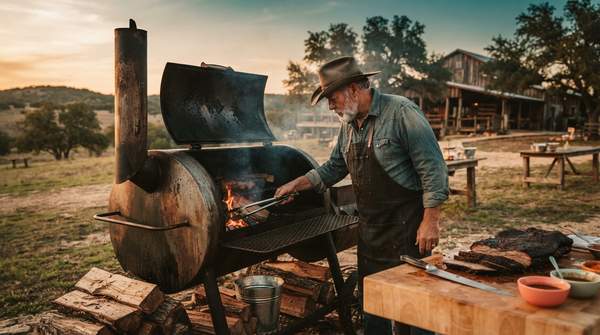
There is no single "Texas barbecue." Beneath the state's famous smoked-meat reputation lie four distinct regional traditions—Central, East, West, and South—each traceable to a specific cultural group that arrived or emerged there before and after the Civil War. Food historian Robb Walsh traces the four styles to enslaved African Americans on East Texas plantations, Hispanics in the Lower Rio Grande Valley, German immigrants in the Hill Country, and subsistence farmers of Scots-Irish descent, each with their own meat-cooking methods. Understanding those origins is the key to distinguishing what lands on your butcher paper today.
Cultural Crossroads: Shaping Early Texas Barbecue
Texas barbecue was never invented by one people; it accumulated. In the middle of the 19th century, German and Czech immigrants began arriving in Central Texas, bringing traditional central European culinary methods, including smoking and sausage processing. Their butcher-shop traditions would prove decisive to one region's style.
Meanwhile, in the eastern part of the state, African American communities—many descended from enslaved people on plantations—carried forward a Southern barbecue tradition built on slow smoking and sauced meats. In the south, along the Rio Grande, Hispanic communities practiced pit-cooked barbacoa, a Mexican tradition of cooking whole animals in the earth. The post-Civil War expansion of cattle ranching then supplied the common thread: beef became widely available and, as an academic study of Central Texas barbecue notes, remains the meat most characteristic of Texas barbecue overall.
The Rise of Regional Styles: A Culinary Map
What began as parallel traditions hardened into recognizable regional styles through the machinery of commerce and regulation. According to the Stanford analysis by organizational sociologists studying Central Texas barbecue, an early turning point came when food cooked in earthen pits was judged unsanitary by health inspectors after the Progressive Era reforms of the early 1900s. Indoor German smokers became the model for barbecue restaurants, which is why many people consider the old meat markets the quintessential Texas barbecue joints—even though German smoked meats and sausages, as the study's authors point out, aren't really American barbecue.
Another accidental origin: migrant farmworkers began eating the smoked meat on the spot at those markets, turning a preservation product into a meal. From these converging forces—immigrant butchery, African American pit mastery, ranching economics, and borderlands tradition—four styles crystallized, each with its own meat, method, and sauce philosophy.