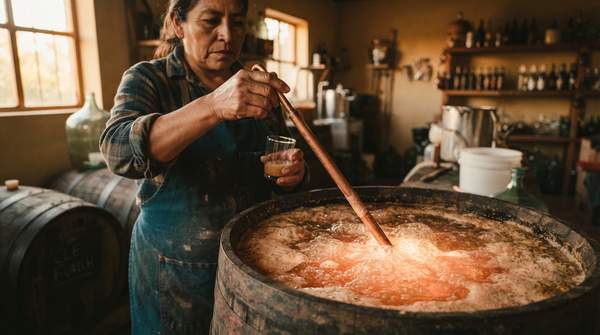
Every dry sherry begins as the same pale, relatively neutral base wine. What turns that wine into a bone-dry, yeasty Fino, a nutty amber Amontillado, or a rich walnut-brown Oloroso is a single fork in the road: how much the wine is fortified, and whether a living film of yeast called flor is allowed to grow on its surface. That one decision, played out inside a centuries-old fractional blending system called the solera, produces three fundamentally different wines from the same starting material.
The Foundation: Palomino Grapes and Initial Fortification
The journey starts in the vineyards of the Jerez region of Andalusia, where the Palomino grape dominates plantings. After fermentation, the young base wine is still ordinary: dry, low in distinctive character, and waiting to be transformed. The decisive intervention comes at fortification, when grape spirit is added to raise the alcohol level—and the target level determines the wine's entire future.
According to Difford's guide to sherry production, wines destined for biological aging under flor are fortified to roughly 15–15.5% alcohol by volume, a level at which flor yeast can still thrive. Wines destined to become Oloroso are fortified to 17% or above, a strength that prevents flor from developing at all. Between those two numbers lies the whole geography of dry sherry.
There is also an intermediate stage worth knowing. Producers describe a phase called "sobreatablas"—literally "over the board"—which sits between fermentation and the wine's final style assignment, when it is transferred into a solera of that style. During this stage, producers who want to encourage flor are careful even with pressing: too much pressure on the grapes, the same source notes, is a key factor affecting flor formation, so gentle handling favors the yeast.
Biological Aging: The Role of Flor Yeast in Fino Sherry
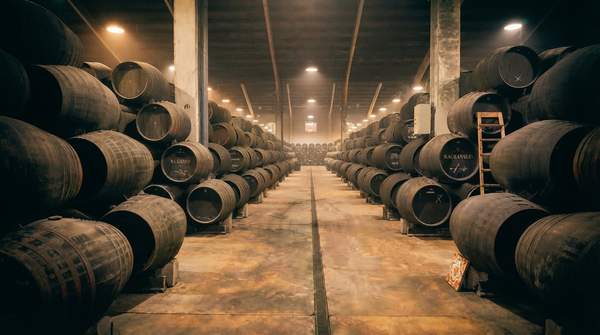
The Consejo Regulador's official production guide describes aging as "without a doubt the decisive stage in the Sherry production process," and for Fino that stage is biological. The wine matures inside oak butts beneath a living film of indigenous yeast known as the velo de flor, which blankets the surface and shields the wine from the air.
The flor does more than protect—it actively reshapes the wine. The official guide credits the velo de flor with endowing the wine with "unique, characteristic qualities," while scientific research on sherry has shown that flor yeasts adapt to fortified wine conditions and generate the key compounds that define sherry's quality profile. In practical terms, the flor consumes compounds in the wine and imparts the fresh, yeasty, delicately saline character that makes Fino the lightest and most delicate of the dry sherries.
Crucially, flor is fragile. It needs the right alcohol level, the right temperature, and a steady supply of nutrients. That is why the Jerez region's climate matters so much: the official guide notes that the complex processes of sherry aging require "very precise environmental conditions, ones that are not always available given the climate of the Jerez Region."
Oxidative Aging: Crafting Oloroso Sherry
Take the other fork. Fortified to 17% alcohol or more, the wine becomes hostile to flor, and no yeast film forms. The wine then ages oxidatively—exposed to controlled oxygen through the wood of the cask and through the racking operations of the solera system. Difford's guide describes Oloroso sherries as wines "without a flor yeast" that "age 'oxidatively' as they are exposed to controlled oxidation in the cask."
The result is a wine of a different color and temperament: darker, richer, nuttier, with the deep, developed flavors that come from sustained contact with air. The official sherry guide notes that in non-biologically aged wines, the oxygen introduced during decanting operations accelerates the maturation process. Where Fino is kept fresh by its yeast blanket, Oloroso is deliberately allowed to breathe—and that openness is the style.
The Solera System: A Dynamic Blending for Consistency and Maturation
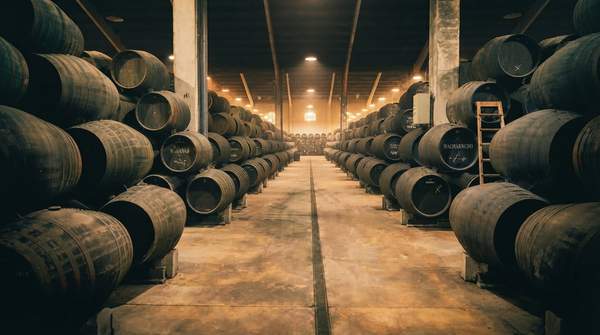
Both paths run through the same remarkable piece of engineering: the criaderas y solera system. Wine is aged in tiers of casks—the oldest tier is called the solera, and the younger tiers above it are the criaderas, or "nurseries." Wine is drawn from the bottom tier for bottling, and that volume is replaced with younger wine from the tier above, which is itself replenished from the next tier up, and so on.
This fractional blending does three things at once. It keeps the house style consistent, because every bottle contains a blend of many vintages. It means a bottle can hold a tiny fraction of very old wine, giving sherry an average age far beyond any single vintage. And for biologically aged sherries, the regular movement of wine through the system feeds the flor, delivering fresh nutrients the yeast needs to survive. The official guide describes this dynamic system as the traditional method of the region and "the only viable method with which to successfully carry out biological ageing"—static aging simply cannot sustain the yeast. Scientific literature confirms the system has remained largely unchanged for centuries while still drawing ongoing genomic and metabolomic research into how flor yeasts behave within it.
Amontillado: The Hybrid Journey from Biological to Oxidative
Amontillado is what happens when a wine lives both lives. It begins exactly as a Fino does: fortified lightly, aged under flor, developing that fresh biological character. Then the flor dies—either naturally, or because the producer kills it deliberately. Difford's guide explains that Amontillado sherries "start as biologically aged Fino sherries, but finish ageing oxidatively after the flor has died or been deliberately killed by raising the alcohol level."
The same source notes the mechanism plainly: you can turn a Fino into an Amontillado by killing the yeast—by adding more fortifying spirit to increase the strength, and/or by increasing the temperature. Once the flor is gone, the wine is typically refortified to 17% or above and enters its second, oxidative phase, taking on darker color and nutty depth while retaining a trace of its biological past. That dual aging is precisely what gives Amontillado its hybrid character: the freshness of Fino at its core, the richness of Oloroso on the finish.
Sherry Production Pathways: A Decision Tree
Trace a single base wine through the system and the logic of sherry becomes a simple branching map. The fork is the fortification decision; the outcome is determined by whether flor lives, dies, or never forms.
| Style | Initial Fortification | Aging Path | Role of Flor |
|---|---|---|---|
| Fino | 15–15.5% ABV | Biological aging under flor | Flor thrives and protects the wine from oxidation |
| Oloroso | 17% ABV or more | Oxidative aging from the start | Flor never develops; wine matures with controlled air contact |
| Amontillado | Starts at Fino level, then refortified to 17% or more | Biological aging, then oxidative aging | Flor dies or is killed, initiating the second, oxidative phase |
Read the table as a pathway, not just a comparison. A wine fortified to 15–15.5% keeps its flor and becomes Fino. A wine fortified to 17% or more never forms flor and becomes Oloroso. A wine that starts on the Fino path but whose flor dies or is killed—by raising alcohol or temperature—crosses over and finishes as Amontillado. The style names on a sherry label are, in effect, records of which path the wine traveled.
Choosing Your Dry Sherry: Understanding the Production Journey
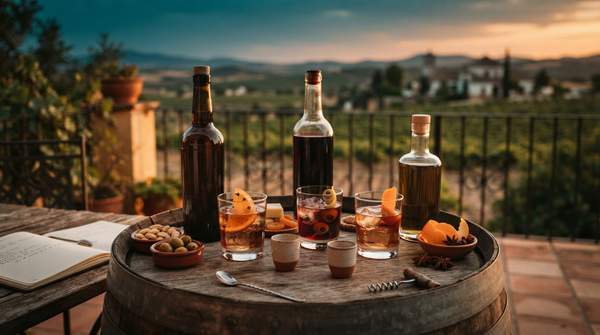
To make an informed choice of dry sherry, consider whether you prefer the fresh, yeasty character of biological aging (Fino), the rich, nutty complexity of oxidative aging (Oloroso), or the nuanced bridge between the two (Amontillado). The measurable indicator is right on the bottle: the chosen sherry's label explicitly states "Fino", "Amontillado", or "Oloroso", indicating its primary aging path. Once you know that Fino means life under yeast, Oloroso means air and time, and Amontillado means both in sequence, that single word on the label tells you most of what you need to know before the cork is pulled.
Sources
- How Sherry Is Made: Solera, Flor, and Fortification — Diffordsguide
- Ageing — SHERRY
- MDPI