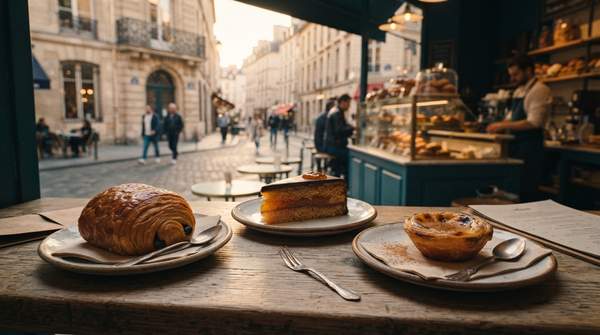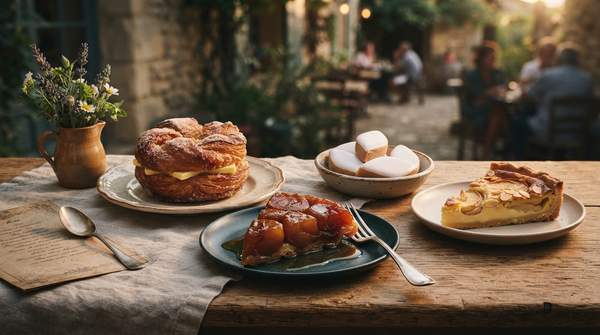
Paris has its éclairs and its mille-feuilles, but France's true pastry soul lives in the regions. If you plan a sweet-toothed route beyond the capital, four specialties stand out: the kouign-amann of Brittany, the tarte Tatin of the Loire Valley, the calissons d'Aix of Provence, and the tarte Normande of Normandy. Each one is a product of its landscape — Breton butter, Loire orchards, Provençal almonds, Norman apples — and each carries a story that turns a dessert into a destination.
Kouign-amann: Brittany's Buttery Delight
Start in Brittany, where the kouign-amann reigns as one of the stars of Breton bakeries. Its name literally means "butter cake" in Breton, and the pastry makes no apologies for it: butter and sugar are its two main ingredients, and as Agnes, a Paris-based French instructor who writes about regional baking, jokes, it's "a source of regular income for all French dieticians."
The construction is what makes it remarkable. Picture croissant dough layered with sugar and butter, then baked until the exterior turns crisp and caramelized while the interior stays dense and multi-layered. The result is rustic — French with Agnes calls it "rustic and quite simple" — yet it remains a fixture of Breton bakery counters precisely because almost everyone loves butter and sugar.
There's a local saying, reported by the France Channel's regional dessert guide, that the kouign-amann is so rich you only need one in a lifetime — though, the same guide adds wryly, "you'll want more." Brittany pairs it naturally with its other sweet emblem, the crêpe, which the same guide describes as a cultural symbol on par with Breton sailor stripes. Seek the kouign-amann wherever Breton bakeries bake it fresh; the caramelized crust is the tell of a good one.
Tarte Tatin: The Loire Valley's Accidental Masterpiece
Head south to the Loire Valley, land of châteaux and royal gardens, and you find the tarte Tatin — a caramelized apple tart turned upside-down. The story behind it is the best kind of culinary legend: the tart was famously invented by accident by the Tatin sisters, who ran a hotel-restaurant in the Sologne region of the Loire. As the France Channel guide puts it, the tart is "a reminder that perfection sometimes comes from mistakes."
The method defines the dessert. Apples are caramelized in butter and sugar, then baked under a pastry crust. Before serving, the whole tart is inverted, so the glistening apples sit on top and the pastry becomes the base. It is a classic French apple tart, typically served hot, often alongside vanilla ice cream or whipped cream.
The Loire's dessert character suits the setting: refined and graceful, in a region the France Channel guide describes as producing desserts that are "light, elegant, and a little regal." Beyond the Tatin, the same region offers delicate fruit tarts — berries or apricots resting on custard in a shortcrust shell — where, the guide writes, "each slice feels like a garden in bloom."