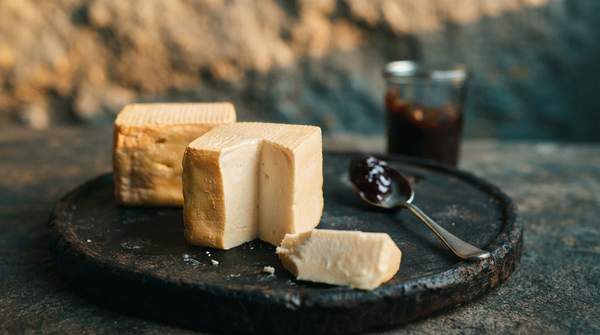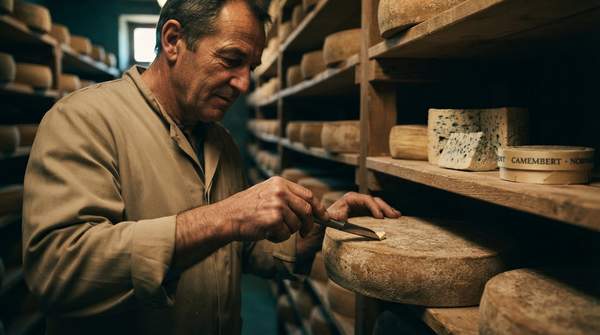
What separates a wedge of Comté from a slice of Roquefort or a round of Camembert? It comes down to three things: the milk, the place, and the rules. Each of these cheeses carries an AOP—Appellation d'Origine Protégée—designation, a French and European legal framework that ties a cheese's characteristics to a specific geographical origin and traditional production methods. Comté is a firm, nutty cow's milk cheese from the Jura Mountains; Roquefort is a tangy blue made from raw sheep's milk and aged in the caves of Roquefort-sur-Soulzon; Camembert is a soft, surface-ripened raw cow's milk cheese from Normandy. Understanding those distinctions is really understanding terroir.
Comté: The Nutty Giant of the Jura Mountains
Comté is the cheese most people picture when they think of French mountain dairying: a large firm wheel made from cow's milk in the Jura Mountains, where pastures and pastoral tradition shape what ends up in the wheel. It is often described as France's most popular AOP cheese, and its character reflects that alpine home—dense enough to grate, rich enough to savor on its own.
Its defining trait is patience. Comté is aged for months rather than eaten fresh, and that extended maturation is where its personality forms: a deep, nutty flavor that grows more complex as the cheese rests. Where a young wheel tastes mild and buttery, a longer-aged one picks up the aromatic depth that makes Comté a benchmark for what slow aging can do to cow's milk. The AOP framework protects that process, keeping production anchored to the Jura rather than letting the name drift to imitators.
Roquefort: The Tangy Blue from Raw Sheep's Milk
Roquefort plays an entirely different game. Among the world's most esteemed blue cheeses—Roquefort, Stilton, and Gorgonzola are the trio most often named—Roquefort is the outlier: while Stilton and Gorgonzola are made from pasteurized cow's milk, Roquefort is made from raw, unpasteurized 100% sheep's milk. That single choice of milk is the foundation of its identity.
The place matters just as much. Roquefort's AOC certification mandates that the cheese be produced only in the Roquefort-sur-Soulzon region of France, where it is naturally aged in the area's caves for at least three months. Those caves provide a unique maturation environment, and the result is a semi-soft, rindless cheese, tangy and crumbly, with distinguishing green veins running through it. The flavor is characteristically blue-cheese pungent and salty. Even the milk is treasured: any sheep's milk left over from Roquefort production is saved to make Valbreso feta.
Comparing France's Iconic AOP Cheeses
Set side by side, the three cheeses sort cleanly along the same five dimensions—milk, region, texture, flavor, and defining rule—which is exactly what the AOP system encodes. Classifying each cheese against that consistent set of attributes reveals how a different combination of factors makes each one unique.
| Cheese | Milk Source | Region (Terroir) | Texture/Type | Flavor Profile | Defining AOP Characteristic |
|---|---|---|---|---|---|
| Comté | Cow's milk | Jura Mountains | Firm, aged | Nutty, complex with age | Mountain production and months-long aging in its home region |
| Roquefort | Raw (unpasteurized) 100% sheep's milk | Roquefort-sur-Soulzon | Semi-soft, crumbly blue with green veins | Tangy, pungent, salty | AOC mandates production only in Roquefort-sur-Soulzon, cave-aged at least three months |
| Camembert | Raw cow's milk | Normandy | Soft, surface-ripened | Fruity, mild | Normandy origin protected under the Camembert de Normandie designation |
The comparison shows the key differentiators at a glance: Comté is the firm, nutty cow's milk cheese of the Jura; Roquefort is the tangy raw-sheep's-milk blue of Roquefort-sur-Soulzon's caves; Camembert is the soft, fruity raw cow's milk cheese of Normandy. No two share a milk source, a texture, or a maturation method.
Choosing Your French AOP Cheese
Why does the AOP label carry such weight? Because it is the legal expression of terroir—and terroir, as the food writer Emily Monaco puts it, encompasses "the landscapes, climate, animals, and, above all, the people that make these cheeses so special." She argues that human traditions are just as important as topography, flora, and fauna in defining a cheese's terroir, since everything from economics to the presence of the Church to a region's pastoral traditions contributes essential elements to its local cheeses. France has over 1,000 of them.
The AOP system turns that cultural argument into enforceable rules. A cheese called Roquefort must come from Roquefort-sur-Soulzon; a Comté must be born of the Jura. The label is not a marketing flourish but a guarantee that the characteristics you taste—the sheep's milk tang, the cave-aged veins, the nutty depth of an alpine wheel—genuinely belong to that place and its methods.
So select a French AOP cheese based on desired milk type, regional origin, texture, and flavor profile, understanding that these characteristics are legally protected by the AOP system. Want firm and nutty for cooking or a cheese board? Reach for Comté. Craving something assertive and salty with blue veins? Roquefort. Prefer something soft and gentle? Camembert de Normandie. The measurable indicator of success is simple: the ability to correctly identify and describe the distinct attributes of Comté, Roquefort, and Camembert when you encounter them—at a fromagerie, a producers' market like the one held Friday evenings in the town of Camembert, or on a restaurant menu. Once you can read those three names and know what each promises, the AOP system has done its job for you.