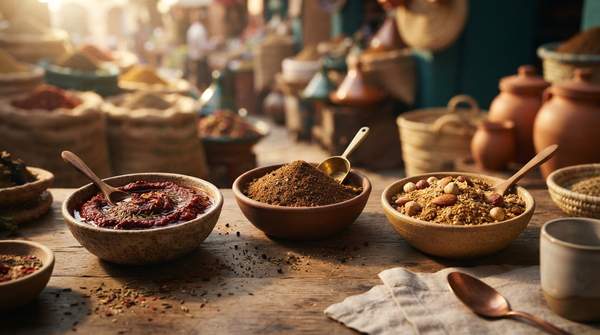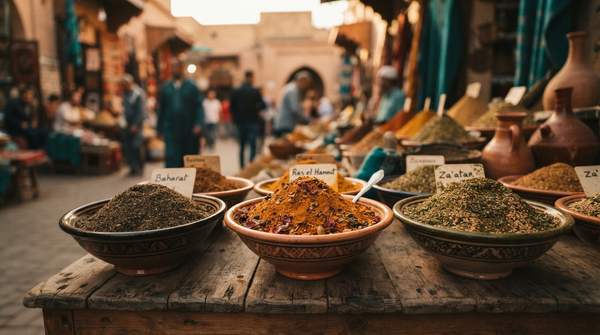
Walk down the spice aisle of any well-stocked market and you'll meet three names that sound exotic but behave very differently in the pan: Baharat, Ras el Hanout, and Za'atar. Here's the short version. Baharat is a warm, all-purpose seasoning built on pepper, cumin, and cinnamon—your workhorse for stews and meat rubs. Ras el Hanout is the elaborate one, a Moroccan blend that can run to thirty ingredients and rewards slow-cooked dishes like tagines and couscous. Za'atar is the odd one out: an herb-and-sesame blend brightened with tangy sumac, made to be scattered over flatbreads, vegetables, and dips rather than simmered into anything. Choose by dish, and you can't go far wrong.
Baharat: The Versatile Warm Blend
The name tells you everything. As the spice specialists at Spice Station Silverlake explain, "Baharat" is simply Arabic for "spices," which is a fair indication of how central this blend is to kitchens across Turkey, Lebanon, Syria, Iraq, and the Gulf states. It's the go-to all-purpose seasoning of the region, and its classic composition typically includes black pepper, coriander, cumin, cinnamon, cloves, nutmeg, and paprika or allspice.
What does that add up to on the tongue? Warmth, mostly—aromatic rather than fiery. A market overview from Grand View Research describes Baharat as a warm mix of cinnamon, cloves, and pepper, used in stews, meat rubs, and soups. That range is the point: because the blend leans on sweet, woodsy spices rather than chilies, it plays well with lamb, beef, and chicken alike, and it dissolves gently into long-simmered broths without turning bitter or one-note.
Think of Baharat as the region's answer to a house seasoning. If a recipe calls for a single spoonful of something "warm and Middle Eastern" without further detail, Baharat is almost always the safe and traditional choice.
Ras el Hanout: The Complex "Head of the Shop" Blend
Ras el Hanout translates from Arabic as "top of the shop"—the best a spice merchant had to offer. It's a North African blend rather than a strictly Middle Eastern one, and it is, by common account, the most complex spice mixture in that entire cooking tradition. Spice Station Silverlake notes that it can contain anywhere from ten to thirty ingredients depending on the maker, and that it represents the pinnacle of the spice blender's art.
What goes in? A typical version includes cumin, coriander, cinnamon, ginger, turmeric, black pepper, allspice, cloves, nutmeg, cardamom, and rose petals or buds. More elaborate versions reach further: dried lavender, mace, dried galangal, orris root, and Monk's pepper. Ruth Grindeland, writing at Sinful Kitchen, gives a similar account—cardamom, cumin, clove, cinnamon, nutmeg, mace, allspice, dry ginger, chili peppers, coriander seed, peppercorn, sweet and hot paprika, fenugreek, and turmeric.
Notice the difference from Baharat: chilies and turmeric appear, and the blend reaches toward floral and earthy depth rather than pure warmth. That complexity is why it belongs in slow-cooked food—tagines, couscous, roasted meats—where time lets the layers unfold. In a quick pan sauce, much of that architecture would be wasted.