Every French pastry you admire sits on one of two foundations: a carefully layered dough or a precisely controlled cream, ganache, or coating. If you want croissants and pain au chocolat, your path is lamination—physical folding, timing, and temperature control. If you dream of glossy chocolate coatings, truffles, and elegant tarts, your path is temperature-sensitive work like tempering chocolate and crafting ganache. Neither is "easier"; they simply demand different kinds of precision. Here's how to tell which one suits you.
The Essence of French Pastry: Philosophy and Precision
Before choosing a technique, it helps to understand what French pastry is actually after. The French approach is built on discipline and technique, but that rigor serves a specific goal: letting ingredients shine rather than masking them. Traditional recipes lean on high-fat European butter, minimal preservatives, and simple, clean ingredient lists, according to the Baltimore bakery Roggenart, which contrasts this with American pastries that often add stabilizers or sugars for shelf life and sweetness.
The philosophy extends to sweetness itself. One of the biggest surprises for customers, Roggenart notes, is how not overly sweet French pastries are—French desserts are designed to be balanced. This matters for a home baker choosing what to learn: precision in French technique isn't fussiness for its own sake. It exists to protect flavor balance and texture, whether that means preserving distinct butter layers in a croissant or a glossy, stable finish on tempered chocolate.
Pillar 1: Mastering Complex Doughs
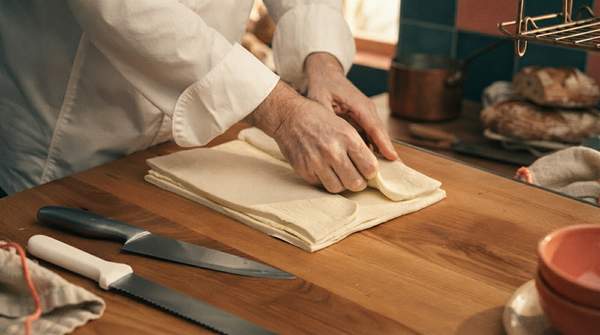
Lamination is the technique behind the buttery, flaky texture of croissants and other viennoiseries—pain au chocolat, chausson aux pommes, and danishes, as the pastry shop Chez Alice describes. The process involves folding layers of butter into dough multiple times to create thin, alternating layers that puff beautifully in the oven. The science is elegant: when the dough bakes, the water in the butter turns to steam, causing the dough to puff and separate into delicate, crisp layers.
The challenge here is physical and environmental. Lamination requires patience, precision, and the right approach, in the words of the kitchen equipment maker Brod & Taylor, whose guide frames homemade croissants as a rewarding project rather than a casual bake. You're managing dough development, proofing, and temperature simultaneously—École Ducasse notes that under-proofed dough comes out dense while over-proofed dough may collapse, and that mastering this process is essential for laminated doughs and brioche. Chez Alice identifies croissants as among the most challenging French pastries precisely because of the precision required in both timing and temperature.