When you bite into a croissant or an éclair, you're tasting a specific, traceable history. The croissant's crescent shape was born in Vienna in 1683, not Paris; its flaky texture is a French invention built on laminated dough. The éclair's hollow shell comes from choux pastry, a technique versatile enough to carry everything from cream to elaborate decoration. And the reason both pastries are taught with precision in schools from Paris to Tokyo is largely the work of two men: Marie-Antoine Carême, who codified pastry in the 19th century, and Auguste Escoffier, who modernized that codified tradition. Let me walk you through how it all fits together.
The Enduring Art of French Patisserie: A Historical Journey
French pastry is known, as the culinary school École Ducasse puts it, for its "precision, artistry, and deep connection to traditional French cooking techniques." That precision is not an accident of culture. It is the residue of centuries in which royal kitchens functioned as competitive testing grounds, where chefs vied to produce ever more impressive desserts for court celebrations. What emerged from that pressure was a craft that could be written down, taught, and preserved. Many of these methods, as one historical account of pastry notes, still form the backbone of training programs used by pastry professionals and bakeries worldwide. The story of how that happened is a story of foreign influence, technical innovation, and two unusually influential chefs.
From Royal Courts to Culinary Innovation: Early Influences
The first foreign infusion arrived with a wedding. When Catherine de' Medici landed in Marseille on October 28, 1533, to marry the future Henry II, her entourage included, according to The Florentine's account of her journey, "an army of chefs, bakers, pastry cooks and distillers." Her marriage brought Italian pastry masters to the French court, where they introduced techniques for delicate sugar work and refined cream-based desserts, and Italian influences mixed with French traditions throughout the Renaissance.
I'll add a caution here, because it matters: Catherine's exact impact on specific recipes is debated. A Cambridge University Press blog on French food-history myths notes that the earliest source to discuss her influence on French cooking actually accused her of corrupting a wholesome culinary tradition with dangerous luxury. Tuscan sources credit her cooks with transforming medieval French cuisine and suggest the origin of macarons and profiteroles can "almost certainly" be traced to her era. What is undisputed is that her arrival brought Italian sophistication into French gastronomy, and that the royal court remained the engine of dessert innovation for centuries afterward.
A Timeline of French Patisserie Evolution
Here is the chronology that ties the whole story together. Read it top to bottom and you can see the cause-and-effect chain: an Italian marriage imports technique, an Austrian bread supplies a shape, French lamination supplies the texture, and two chefs turn it all into a teachable discipline.
| Date / Era | Development or Figure | Impact on Patisserie |
|---|---|---|
| 1533 (Renaissance) | Catherine de' Medici arrives in France with Italian chefs, bakers, and pastry cooks | Italian techniques for sugar work and cream-based desserts enter the French court; her exact effect on specific recipes remains debated |
| 1683 (Vienna) | The Kipferl, a crescent-shaped bread, is created to celebrate the defeat of the Ottoman Empire | Supplies the crescent shape and the ancestor of the croissant — though as a denser bread, distinct from the flaky French version |
| Early 1800s (Paris) | The Austrian-born Marie Antoinette's arrival coincides with the "Viennoiserie" style taking hold in Paris | Austrian baking traditions, including the Kipferl, migrate into the French capital |
| 19th century | Marie-Antoine Carême, the "King of Chefs," codifies pastry and creates elaborate architectural desserts | Pastry becomes a documented, structured art form; his work paves the way for the mille-feuille and the éclair |
| Late 19th / early 20th century | Auguste Escoffier modernizes and streamlines culinary processes | The codified craft is professionalized, with quality maintained through structured, formalized training |
The pattern this timeline reveals is consistent: French patisserie advanced each time a foreign influence arrived and was then refined, documented, and taught as technique. That is the mechanism behind its prestige, not some innate Frenchness of butter and flour.
The Evolution of Iconic Pastries: The Croissant's Journey
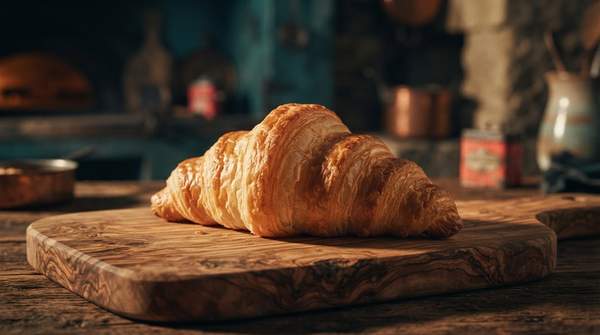
Many people believe the croissant has always been French. It hasn't. As the bakery Roggenart's history of French pastries recounts, its roots trace to 1683 Vienna, where the Kipferl — a crescent-shaped bread created to celebrate the defeat of the Ottoman Empire — was born. The shape migrated to France when the "Viennoiserie" style began to take hold in Paris, an arrival that coincided with the Austrian princess Marie Antoinette coming to France.
But here is the crucial distinction: the original Kipferl was a denser bread. What makes the modern croissant a French pastry is the texture, and the texture is pure technique. The croissant as we know it is made with laminated dough, and that lamination — not the crescent shape — is the French contribution. The shape is Austrian; the flaky, airy interior is the product of French pâte feuilletée methods. Without that technical refinement, the croissant would still be a bread, not a pastry.
Mastering the Craft: Foundational Techniques of French Patisserie
Two techniques carry an outsized share of French pastry's identity, and each one explains a specific pastry's character.
Laminated dough (pâte feuilletée). École Ducasse describes the croissant as made by "folding butter into the mixture over several turns to create delicate, airy layers." That is lamination in a sentence: butter is enclosed in dough, and the packet is folded and rolled repeatedly so the butter alternates in thin sheets between layers of dough. In the oven, the water in the butter turns to steam and pushes the layers apart, producing the flaky, golden structure that defines the croissant and its cousin the pain au chocolat, prized for its rich center and crisp, buttery exterior. Mastery of lamination is what separates the shattering, honeycombed croissant from the dense Viennese original.
Choux pastry (pâte à choux). Choux is the other pillar. It is a versatile dough that expands as it bakes to create hollow interiors, which is exactly what an éclair or a profiterole requires: a crisp shell with room inside for cream. The same dough, as Chez Alice's guide to pastry techniques explains, underpins everything from éclairs to macarons' assembly, and its structure allows for fillings and decorative applications. Once the shell exists, piping takes over — a trained-hand discipline that, in that same account, brings "structure, consistency, and elegance" and ensures even distribution of filling so every bite is balanced.
Notice what these two techniques have in common: neither is a recipe so much as a system. Learn lamination and you can make croissants, pain au chocolat, or mille-feuille. Learn choux and you can make éclairs, profiteroles, or a dozen other shapes. That system-level thinking is precisely what the great codifiers formalized.
The Architects of Modern French Patisserie: Carême and Escoffier
If you want to know why French pastry became a respected discipline rather than a collection of family recipes, look to two chefs. Marie-Antoine Carême, the 19th-century "King of Chefs," is the one who codified the art of pastry. Roggenart's history describes him as turning "baking into architecture," creating elaborate structures that paved the way for the mille-feuille and the éclair, and establishing the standard that a pastry must be a feast for the eyes as much as the palate. His detailed written works classified pastry techniques, and his emphasis on structure and design influenced generations of bakers.
Auguste Escoffier then modernized what Carême had built, streamlining processes while maintaining quality. His contribution was less about inventing new desserts than about the structured approach itself: the formalized training and systematic organization that turned a craft into a profession. Together, as one account puts it, they shaped French pastry into a respected culinary discipline — and their combined influence continues to guide pastry instruction in both high-end kitchens and neighborhood bakeries worldwide.
This is the part of the story I find most underappreciated. The éclair you buy today exists in its current form because someone wrote the technique down, someone else organized how it should be taught, and generations of bakers since have inherited that documentation rather than reinventing it.
The Enduring Legacy of French Patisserie
So what should you take from all this? French patisserie's global prestige is rooted in a continuous historical process of technical refinement, codification, and adaptation of foreign influences, driven by influential chefs. The croissant is Austrian in shape and French in texture; the éclair is possible because choux expands into a hollow shell; and both are teachable today because Carême classified the techniques and Escoffier professionalized how they're passed on.
The measurable proof of this legacy is visible right now: pastry schools and high-end bakeries worldwide continue to adhere to and build upon classic French techniques, with lamination and choux work forming the backbone of professional training. The next time you're near a serious pastry counter, look at the layers in a croissant or the filled shell of an éclair — you'll be looking directly at three centuries of documented refinement, still being reproduced by hand.
Sources
- French pastry: classic recipes and famous names — École Ducasse
- A Legacy in Layers: The History of French Pastries - Roggenart
- L'Italienne: Catherine de' Medici — The Florentine
- Busting French Cuisine Myths - Fifteen Eighty Four — Fifteen Eighty Four | Cambridge University Press - The Official Blog of Cambridge University Press
- The whole story of Catherine de Medici — Firenzemadeintuscany
- The Art of French Pastry Techniques: From Laminating to Piping — Chezalicecafe
- The Hidden Story Behind French Desserts: What Master Pastry Chefs Neve — Ocemiam French Banana Bread & Baby Cakes